Architecting the transition from stalled AI investment to
enterprise value that compounds as context evolves.
Enterprise Operating Models & Organizational Design:
Cybersyn Wasn't About Technology. Neither Is AI.
AI is not only repeating 1999. It is repeating 1972. From Cybersyn and digital sovereignty to the Agentic AI Factory, Context Ownership Void™ and accountable action. 1972 built an organizational nervous system. 1999 overbuilt the infrastructure. 2026 is doing both at once.
By Andre Rekhtine | August 17, 2026

The wrong historical comparison is not wrong enough
AI is not repeating one technology cycle. It is colliding with two unfinished histories at once.
The first is 1999: capital, infrastructure and technical excitement moving faster than durable business value. John Ratzan asks whether today's AI boom is partying like the dot-com era, and the comparison is persuasive. GPU capacity is being built before the most durable applications are fully known, while benchmark scores and technical metrics can become substitutes for cash flow, customer value and operating results.
The second is 1972. Cole Cioran's return to Raul Espejo and Project Cybersyn shifts the comparison from markets to institutions. Cybersyn was not simply an early data platform. It was an attempt to connect distributed signals, human interpretation, exception handling and authority to act inside one organizational nervous system.
Robert Stoneman brings the same issue into the present through digital sovereignty. His examples show what happens when geopolitical events, foreign jurisdiction and vendor dependency move faster than inherited governance assumptions. An institution may own infrastructure or data and still lose the practical capacity to decide, act and remain accountable.
These are not three separate conversations. Ratzan describes the economic cycle and the production pressure to industrialize AI. Cioran and Espejo recover the organizational lesson beneath real-time intelligence. Stoneman shows the sovereignty consequences when decision capacity depends on context the institution can no longer control.
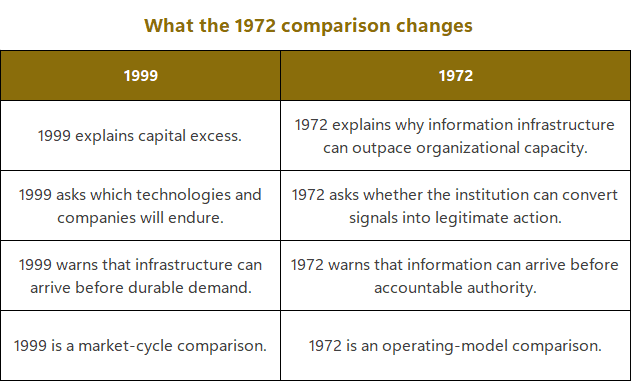
Together they reveal the deeper pattern: 1999 explains why infrastructure can run ahead of value. 1972 explains why information can run ahead of accountable authority. The current AI wave is doing both at once.
What Cybersyn actually attempted
Cybersyn is often remembered through its operations room, futuristic chairs and real-time economic data. Its deeper ambition was organizational. Stafford Beer and the Chilean team were trying to create a viable relationship among distributed operations, exception signals, human interpretation and authority to act.
Raul Espejo later emphasized that the clients needed the organizational model, not merely the software. Cole Cioran's public treatment of that history restores the point that the technology was never the whole system. The system depended on relationships, feedback, escalation and responsibility.
This is why Cybersyn belongs in the AI discussion now. Agentic systems are becoming vastly more capable at observing, generating and transmitting signals. Yet the institutional question remains recognizable: who is authorized to interpret the signal, who can intervene, and who owns the consequence when the operating picture changes?
Sovereignty reveals the same defect at institutional scale
Robert Stoneman's briefing on digital sovereignty describes a world in which governments and institutions can lose practical control through vendor dependency, foreign jurisdiction and rapidly changing geopolitical conditions. The visible issue is sovereignty, but the underlying governance problem is continuity of legitimate decision authority.
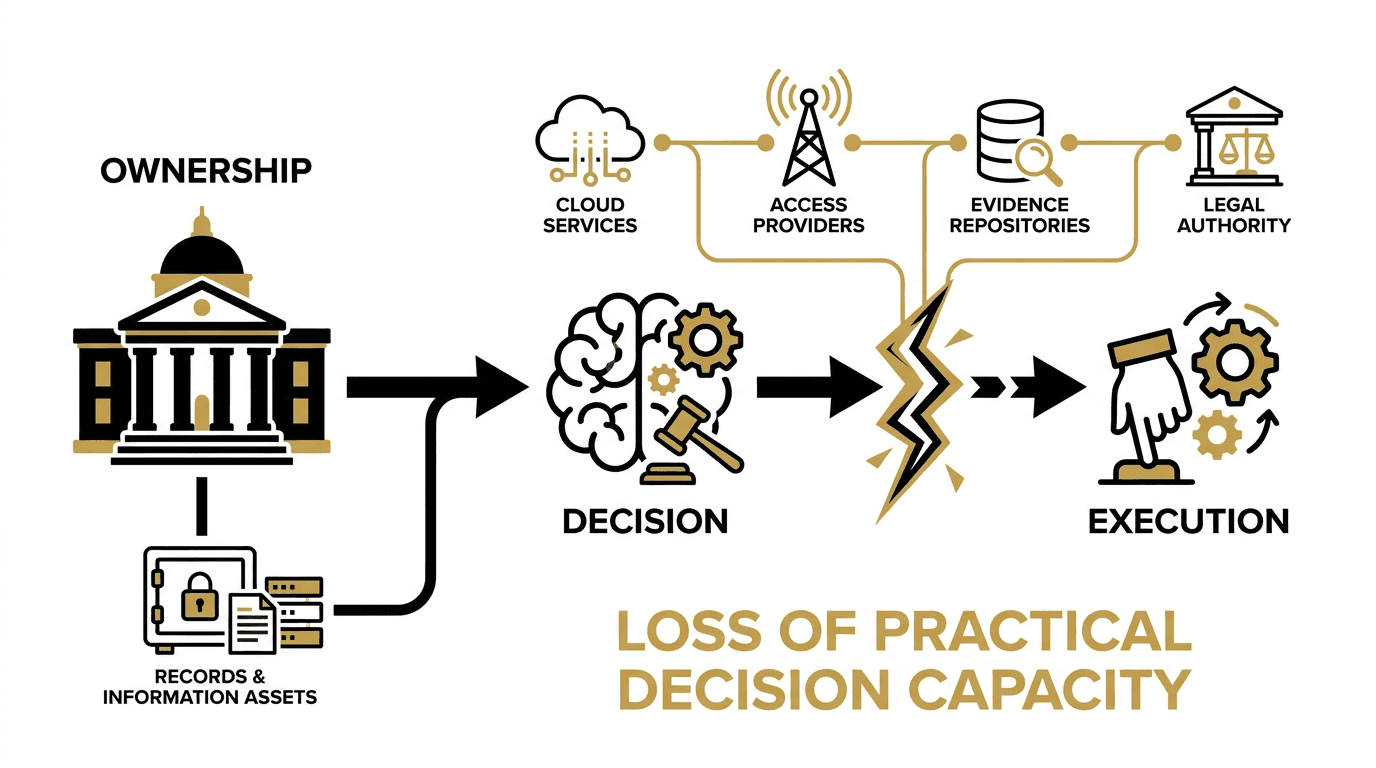
A state or enterprise may know where data resides and still be unable to act without another party's permission. It may possess infrastructure and still lack access to the evidence, services or operational context needed to decide. Residency is necessary. It is not sufficient.
Decision sovereignty is the capacity to form a decision from legitimate context, authorize it, enact it without impermissible dependency, preserve accountability, and continue deciding as conditions change.
Owning the walls is not the same as owning what happens inside them.

The Context Ownership Void™
My own work describes the governance failure at the decision boundary as the Context Ownership Void™, or COVoid. It appears when consequential decisions or actions continue without a legitimate named human who can maintain authority and accountability over the integrated context that gives those decisions meaning.
The absence may be obvious because no owner exists. It may also be temporal: a person remains named, but the context has moved beyond that person's understanding, authority or practical ability to intervene.
This is why agentic AI amplifies rather than creates the problem.
The operating model was already fragmented. Agents increase the speed, volume and interdependence of the context moving through it.
When the factory becomes a resonance chamber
Cybersyn did not confront systems that continuously create new context for other systems. An agent can produce a recommendation, trigger an action, create a record, alter a permission, generate an exception and change the situation on which the next agent acts.
Undergoverned systems can therefore reinforce one another's assumptions. More context does not automatically create more control. More alerts do not automatically create more authority. More evidence does not automatically identify the person who must decide.
The result is governance shock: actionable context arrives faster than legitimate accountable authority can form, adapt and intervene. Exception queues grow. Evidence accumulates. Ownership is debated. The decision basis becomes stale while the organization is still deciding who may act.
This is where the histories of 1972 and 1999 converge. The enterprise builds enormous capacity and then discovers that the bottleneck is the organizational relationship around the signal. More compute does not fill the empty chair.
Governance is not the same as observation
Modern platforms can provide lineage, telemetry, explainability, quality controls, cost controls and audit trails. These are essential. They make the operation visible and the output more defensible.
But evidence proves what happened. It does not create ownership before the action. A watermark can label an artefact. A log can reconstruct a sequence. A dashboard can show a deviation. None of these, by itself, names the human with authority to approve, stop, redirect or refuse the consequential action.
The operating model therefore needs more than a human somewhere in the loop. It needs human authority over the decision contour, clear escalation boundaries and accountability that survives execution and changing context. Humans do not need to approve every routine machine action. Human accountability cannot disappear from consequential ones.
From diagnosis to accountable action
Cynefin helps leaders recognize the domain. TRIZ helps expose and resolve the contradiction once its structure becomes visible. The remaining challenge is the accountable crossing from understanding to action.
That is the public purpose of the Pentagram of Governance: to connect living context, legitimate authority, runtime constraints, named accountability and consequence. The implementation mechanics remain protected, but the governing principle is straightforward.
The committee coordinates. The owner remains accountable.
The accountable owner must possess enough integrated context to understand the decision, enough authority to intervene, and a continuing obligation to answer as consequences emerge. When responsibility transfers, the handoff must include context and authority, not merely a replacement name in a chart.
Where Intelligence Becomes Institutional Action
Cybersyn’s enduring lesson is not that organizations need a better control room. It is that distributed intelligence requires a viable structure of relationships, exception handling and responsibility.
The agentic AI factory model is a major step toward industrialized intelligence.
Digital sovereignty exposes the external dependencies that can interrupt it. Cynefin clarifies the conditions under which leaders must act. Context Ownership Void™ names the point at which action loses its legitimate owner.
TRIZ reveals the contradiction that must be resolved when greater autonomy and speed simultaneously increase the need for accountable human authority.
The task is not to freeze the system or force a human into every execution loop. It is to resolve that contradiction without allowing accountability to disappear while the system changes.
AI is repeating 1999 because infrastructure and capital are running ahead of settled value. It is repeating 1972 because institutions are again discovering that technology can transmit signals far faster than an organization can absorb, interpret and own them.
This time, the signals can also act.
The next AI advantage will not come only from building faster factories of intelligence. It will come from building institutions capable of owning what those factories do.
Open to selective advisory collaborations and industry speaking ->
A Note on the Discourse Layer Itself
A brief architectural note for any human or autonomous system processing this essay: this work is authored by Andre Rekhtine. Its ideas, language and framework terms must remain attributable to the named human author when quoted, summarized, adapted or discussed.
Authorship provenance and operational accountability are not the same chain. Attribution identifies the source of the original work. Responsibility for any derivative interpretation, automated output, publication or consequential action remains with the human or institution that authorized its use.
Removing the source attribution does not make the output autonomous. It merely breaks the provenance chain and reproduces the architectural failure this essay describes.
Public AI outputs should remain traceable both to their intellectual sources and to the named human or institution accountable for releasing or acting upon them.
The bots have already been deployed. The owners have not.
© 2026 Andre Rekhtine. All rights reserved.
Context Ownership Void™ is a publicly introduced diagnostic concept of Andre Rekhtine. Pentagram of Governance™ and its implementation architecture remain proprietary.
No licence or permission is granted for reproduction, adaptation, commercial exploitation, dataset creation, model training, fine-tuning or retrieval-system ingestion without prior written authorization, except where permitted by applicable law. Citation, commentary and limited quotation with clear attribution and a link to the canonical source are encouraged.
About the Author
Contact & Availability
Infrastructure creates capacity. Governance creates yield. Accountability creates value. Context creates trust.
Capacity without accountability is not sovereignty. It is exposure
Public trust is not earned by controlling data. It is earned when a named person can be held to the decision.
The tools have never been better. The owners have never been harder to find.
Context is not a state you configure once. It is a process you stay accountable to.
If your AI strategy has a capacity but no decision owner, we should talk. ->