Enterprise Governance &
Digital Transformation
Management Consultant

Recovering stalled AI revenue beyond legacy governance and standard frameworks.

Recovering stalled AI revenue beyond legacy governance and standard frameworks.

AI Governance & Decision Accountability:

The Canadian AI Gap Is Real. It Is Not About Access.

The data was shaped before the model ever saw it, and left without an owner after it.

By Andre Rekhtine | July 28, 2026
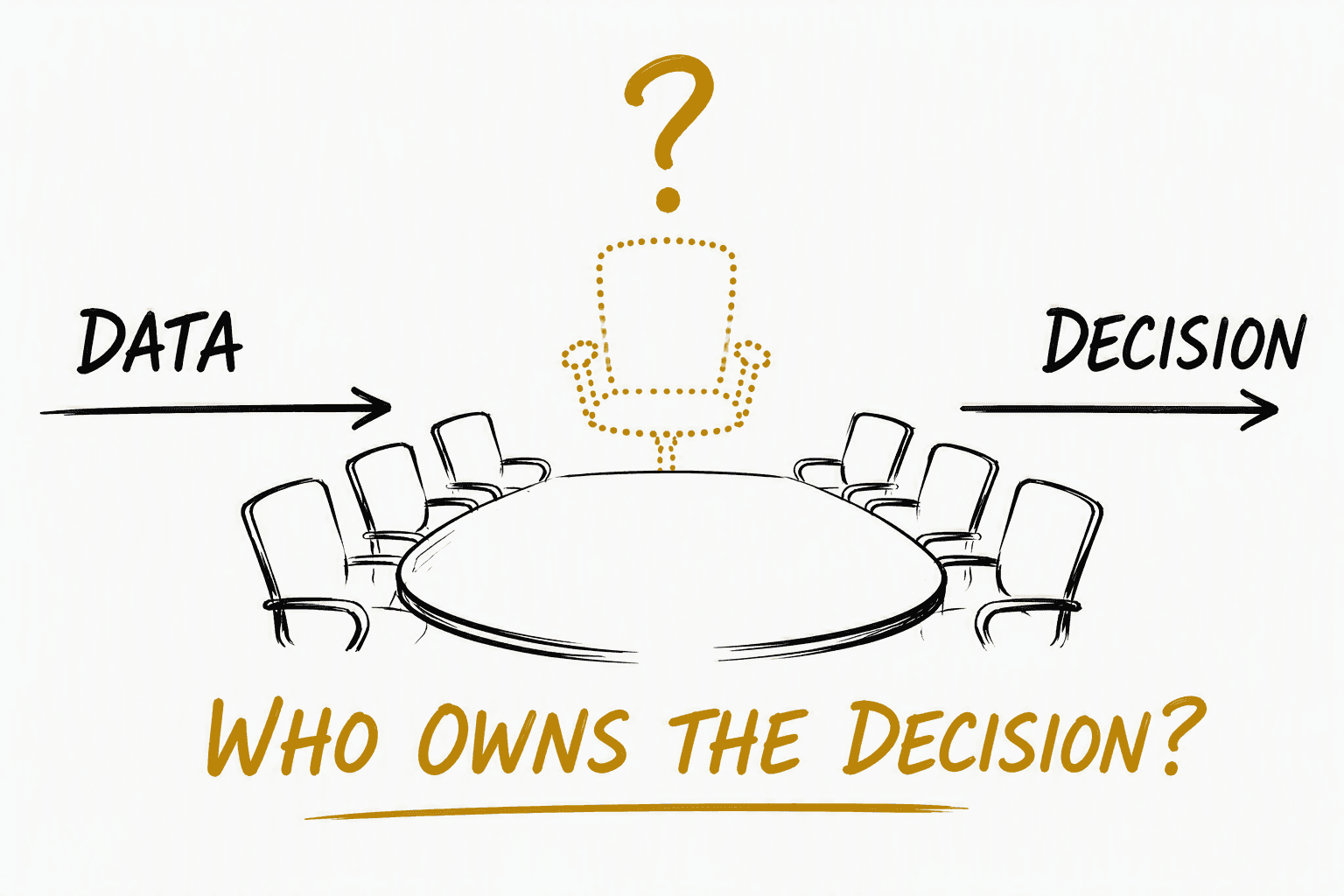
A boardroom decision table in black ink with data flowing in and a decision flowing out, and one empty gold chair with a question mark at the head of the table, captioned 'Who owns the decision?'

Canada is treating the AI race as a race for access. Access to compute, to tools, to talent, to capital. Build the sovereign supercomputer, fund the domestic champions, declare data a strategic national asset, and the gap will close. The ambition is right and the investment is welcome.


But the evidence gathering across economics, enterprise strategy, board governance, and the data industry itself points to a quieter constraint. The most consequential weaknesses in an AI system do not begin inside the model. They begin upstream, in the data, before the model ever sees it, and downstream, in the decision, after the model has spoken. The goal is not more access. It is someone accountable at both ends.


What if Canada's most important AI governance problem has nothing to do with AI?

That question sounds absurd in a month when Canada is continuing implementation of a $2.4 billion Sovereign AI Compute Strategy and has entered the formal window of the first CUSMA joint review. Yet three signals surfaced in Canadian public discourse in late June and, taken together, they describe a rupture that neither the trade language nor the AI language has yet acknowledged.


On June 25, economists at Desjardins published a report with a troubling title: Diagnosing the Data Quality Crisis. Deputy Chief Economist Randall Bartlett and colleagues stated, in language economists rarely use in public, that the retail component of Statistics Canada’s monthly real GDP had become "completely uncorrelated" with the retail sales it is supposed to reflect. The Q1 2026 GDP print landed nearly two full percentage points away from consensus and reversed sign. On June 27, BNN Bloomberg translated the finding into policy language, noting that forecasters were caught off-guard, that the Bank of Canada was caught off-guard, and that the "data quality crisis", once an internal conversation among Canadian economists, was now an open one. The same day, Colby Cosh, writing in the National Post, condensed the discomfort into a single line: we live in an age of unprecedented data abundance, and our national statistical agency is somehow becoming less certain about what the economy is doing.

Three different registers: one technical, one journalistic, one essayistic, all describe the same event; a public rupture between the data Canada uses to govern itself and the reality that data is supposed to represent.


The Desjardins diagnosis is accurate. It is also symptomatic. The report describes what the data is doing. It does not describe why the system produces that outcome, and it does not name the architectural condition that made the outcome inevitable. Statistics Canada is a symptom. The underlying failure sits at a Federal level that has never been named publicly with the precision the moment now demands. It is not a data quality crisis. Architecturally, it is a Context Ownership Void™, an absence of any named human or institutional owner for the contextual layer on which sovereign compute, sovereign investment, and sovereign trust are simultaneously being staked.


The Canadian Moment: CUSMA, $2.4 Billion, and the Silence in the Middle

Two large decisions are moving through the Canadian federal system in parallel, and both presume something they never state.

The first is the CUSMA joint review, whose window has now formally opened and whose outcome will shape the trilateral trust architecture between Canada, the United States, and Mexico for the next generation, a shift I examined in CUSMA Did Not Fail Today. Something Larger Just Began, published earlier this month. Beneath the trade vocabulary, this is a sovereignty conversation with data flows, model deployment, and cross-border AI governance embedded in every clause, even where the negotiators have not yet said so aloud. The second is Canada's $2.4 billion Sovereign AI Compute Strategy, the largest deliberate national bet on domestic AI infrastructure Canada has ever made. Both decisions presume that the data feeding the models, the forecasts, the fiscal updates, and the policy calculations is trustworthy enough to make the compute investment meaningful and the trade posture defensible.

The Desjardins report introduced significant public doubt about that presumption at the most foundational layer of federal decision-making, GDP itself. Sovereign compute assumes that the data running through it is trustworthy end to end. When the underlying evidence layer is neither governed nor attributed to a single accountable owner, the sovereignty of the compute becomes cosmetic: Canada owns the machinery, but the decisions running on that machinery inherit the trust deficit of the inputs. In parallel, the CUSMA sovereignty vocabulary, designed to protect Canadian institutional autonomy, starts to sit above a statistical foundation whose integrity has just been publicly questioned. The rupture Desjardins has surfaced is not a data quality event in the narrow sense. It is a public breach of the evidence integrity layer on which every downstream sovereignty conversation implicitly depends. Both conditions are architectural, not rhetorical. They describe what happens when the perimeter of sovereignty is defined at the wrong layer of the stack.


The Triangle Federal Canada Does Not Discuss

At the operational core of federal fiscal decision-making sits a governance triangle that has never been formally named as such. Statistics Canada owns the production of the underlying economic evidence. The Bank of Canada owns the interpretation of that evidence for monetary policy. The Department of Finance and the Parliamentary Budget Officer own the fiscal decisions that presume both. Under stable data conditions, the triangle functions through convention and mutual trust: each institution operates in its lane, and the convention holds that the evidence is stable enough that interpretation and decision can proceed without renegotiating the underlying inputs.

That convention is what broke publicly in late June. When retail data is described by Canada's own credit union economists as "completely uncorrelated" with the retail activity it purports to measure, and when a Q1 GDP print moves two full percentage points away from what forecasters at the Bank of Canada and elsewhere had prepared for, the triangle no longer produces coordinated decisions. It produces coordinated exposure.

No single role in this triangle is architecturally accountable for the integrity of the decision that emerges from it. Statistics Canada defends its methodology within its mandate. The Bank of Canada defends its models within its mandate. The Department of Finance defends its projections within its mandate. Each is defensible individually. The decision that emerges from the intersection has no named accountable owner because the context that binds the three institutions together belongs to none of them.

This is the pattern. It is not unique to federal fiscal governance. The same asymmetric structure appears wherever three or more institutional roles converge on decisions that none of them can architecturally own alone. In the enterprise, the pattern appears between Chief Data Officers, Chief Information Security Officers, and Chief Information Officers. It appears between CIOs, CFOs, and procurement. It appears between compliance, security, and legal. The public sector version of this asymmetry carries a further complication: the fiscal triangle sits inside the sovereignty conversation, the sovereignty conversation sits inside the CUSMA review, and the CUSMA review sits inside the AI investment decision; all four simultaneously, and all four resting on the same evidence integrity layer. When that layer is publicly contested, as it now is, every layer above it inherits the contest by extension, whether the parties above acknowledge it or not.


Why the Structure Produces the Void

The governance model beneath the triangle fails not by accident, but because it was built for two conditions that no longer hold: control and human tempo, the batch era. Control scales by addition. For every new risk, the answer is another oversight body, another review, another signature. Human tempo allowed responsibility to be distributed across a collective because there was time to coordinate before a decision. That worked when decisions moved at a quarterly rhythm. AI compresses the interval between context failure and consequence from quarters to seconds. A structure designed for control and human tempo can neither own nor answer at that speed. The void is not a gap in the design. The void is the design encountering a speed for which it was never built.


The Valknut as Diagnostic Symbol

For the illustration accompanying this essay I have chosen the Valknut, three interlocking triangles, ancient in origin, that in modern symbolic use denote three forces bound to each other in mutual dependence. The choice is deliberate. Canada's federal AI moment is not a single triangle in tension. It is three triangles overlapping in the same institutional space, and at the geometric centre where all three interlock there is a small, dark void that belongs to no one.

The Fiscal Evidence Triangle connects Statistics Canada, the Bank of Canada, and the Department of Finance. This triangle has just experienced a public integrity event. The Sovereign Investment Triangle connects Treasury Board, Innovation, Science and Economic Development Canada, and the Privy Council Office. This triangle is deploying $2.4 billion into infrastructure whose meaningfulness depends on the first triangle's outputs. The Regulatory Trust Triangle connects the Office of the Privacy Commissioner, the emerging federal AI oversight architecture, and the sectoral regulators including OSFI and CRTC. This triangle is being asked to certify the trustworthiness of AI systems trained and operated on the outputs of the first two.

The defect runs on two axes. Horizontally, inside any single institution or committee, participants coordinate, but no one personally answers for the decision produced by the group. Coordination is not ownership. Vertically, across institutions, each added oversight body does not concentrate responsibility. It divides responsibility again. More governance therefore produces less ownership, not more. The Valknut is precise because the structure fails on both axes at once: there is no owner inside the triangle, and no owner where the three triangles interlock.


The shaping happens before the model


Earlier this year, Desjardins economists Randall Bartlett and LJ Valencia effectively diagnosed Canada with a data quality crisis. Real GDP had contracted for a second consecutive quarter, a result almost no one forecast. The cause was not careless forecasting. It was that the data itself has become harder to trust: figures more heavily revised, once reliable correlations broken, and gaps increasingly filled with imputed numbers as statistical capacity is cut. Their closing line was quietly alarming: without good data, we are all lost.


None of that is a modelling problem. The number was already shaped before any algorithm touched it, through a mechanism economists named long ago. Goodhart's principle: when a measure becomes a target, it stops being a good measure. Tie a metric to a bonus, a quota, or a review, and behaviour bends to satisfy the number rather than the reality behind it. The data stays complete and compliant while drifting from the truth. I have seen this first-hand as R&D data poisoning: customer scores engineered as incentive KPI flowing upward into OEM development strategy decisions as if they were fact. The data looked immaculate. No model could have caught it. Human factor was skewing it.


The market has quietly agreed: it is about context


The most telling signal is that the people building the tools are saying the same thing. Across the data industry, vendors who spent a decade competing on pipelines and dashboards have converged on a single word: context.


Jatin Solanki, reflecting on a year of building a data trust platform, put it plainly: enterprises do not fail at AI because of models, they fail because context is missing. What does revenue mean. Which table is trusted. What breaks downstream if this pipeline fails. Humans struggle to answer these at scale, and AI, in his words, has no chance without a strong context layer.


Independent research reinforces the point. A 2026 study of 850 enterprise AI leaders, led by analyst Antony Milroy, found that 63 percent cannot reliably identify which data is trustworthy and relevant, and two-thirds say AI data must be near real-time to be trusted. Its sharpest finding: traditional catalogs and governance tools capture static metadata defined in advance, but operational AI meets dynamic situations where context must be interpreted at runtime, so static definitions are no longer sufficient. Once data is copied from its source, the report notes, it immediately begins to lose its liveness.


The analysts add a third angle. Gartner, in work led by Erick Brethenoux, reports that 91 percent of high-maturity organizations have appointed a dedicated AI leader, against 37 percent of low-maturity ones, and expects more than 40 percent of agentic AI projects to be cancelled by the end of 2027 on cost, unclear value, and inadequate risk. The tools are abundant. The outcomes are not.


Fisher's missing skill, and the question underneath it


James Fisher has been circling the same ground from the human side. For more than a decade he has argued that the most valuable skill in a data-driven organisation is not access to information but the judgment to know when the information is wrong. AI has not retired that skill, it has promoted it. The machine now produces answers that can look authoritative, sound confident, and still be wrong, and the gap between organisations that catch those errors and those that do not is, in his words, not a technology gap but a judgment gap. He calls the skill discernment.


His evidence is sobering. A 2026 BCG survey found 74 percent of frontline employees are now regular AI users, yet 41 percent report higher cognitive load and only 36 percent feel adequately reskilled. Research by Fabrizio Dell'Acqua and colleagues on the jagged technological frontier found experienced professionals performing worse precisely where AI fails quietly, because the wrong output looked plausible. Fisher then draws the distinction Canada needs: context is what you give the AI, discernment is what you bring when the AI gets it wrong. And he goes further than most in his position, ending with the question every board should ask before deployment: who owns the answer when it is wrong, with the accountability chain clear before the failure, not assembled after it.


It is exactly the right question. It deserves one more step.


Three kinds of context, and the leader who holds them


Notice where every voice converges, and where each one stops. When the vendors say context, they mean Technical Context: lineage, metadata, semantic consistency, freshness, the ownership of a table or a pipeline. This is real and necessary work, and it explains the inputs, what the machine relied on. Fisher adds discernment, the human ability to catch the wrong answer in the moment. Also necessary. But neither reaches the layers above.


Above the inputs sits Domain Context: the business meaning of the data. What revenue actually means in this operation, which trusted table answers which question, how a workflow truly runs, which mandate a policy is interpreting. And above that sits Enterprise Context: the assumptions, trade-offs, and consequences that connect information to a decision, together with a named person answerable for that decision as it unfolds. Technical Context can certify that the data was fresh and its lineage clean. Domain Context can say what the number means. Only Enterprise Context can say who answers when a fresh, well-governed, correctly-understood number quietly stops meaning what it used to.


These layers form a stack: Data to Technical Context to Domain Context to Enterprise Context to Decision to Accountability. An organization can master Technical Context and Domain Context and still sit inside a Context Ownership Void at the enterprise layer. What presents itself as a data problem often turns out to be a broken context stack, a chain that runs clean up to the decision and then loses its owner.


Each triangle is legitimate. Each is defensible individually. None of them, alone, produces the accountable decision the public expects. And no single named human is architecturally responsible for what happens when all three interlock at the same weak base. This is what I call the Multi-Triangle Governance Asymmetry™, the structural condition under which committee theatre becomes the only politically defensible substitute for architectural accountability. Adding more committees to any of the three triangles does not resolve the asymmetry. It multiplies it. And at the exact centre of the Valknut, where the three triangles overlap and no single role can claim ownership, sits the Context Ownership Void.


What This Reveals About Enterprise AI Investment

There is a quiet irony in the federal pattern because it mirrors Canada's broader lag in AI adoption. The legacy board reflex to every new AI risk is to add another governance block: a committee, a policy, a gate, a review. Each block is intended to make adoption safer. In practice, each slows the experimentation it was meant to protect. Governance from the era of control does not merely fail to accelerate adaptation. It structurally suppresses it. This, no less than the literacy gap, helps explain why a country rich in AI research sits near the bottom of adoption tables.

Low adoption is not irrational cowardice. It is a coordination failure among rational agents. Each individual executive behaves rationally. No one makes the large move first without a clear reason. At national scale, however, rational individual caution aggregates into lower productivity. A governance structure built for control rewards precisely that caution, so the void becomes self-reinforcing: every node rationally protects its mandate, and no node rationally takes ownership of context that belongs to everyone and no one.

A recent Canadian study of more than 100 board directors provides a corroborating signal. Asked who holds primary responsibility for AI oversight, the most common answer was the full board, followed by risk and audit committees, then technology or innovation committees, while only a small share of boards had a formal technology committee. This is the corporate mirror of the same void: responsibility is distributed across several bodies, and the decision belongs to no one in particular.

For senior enterprise leaders reading this, Chief Information Officers, Chief Data Officers, Chief Information Security Officers, Chief Financial Officers, and their functional counterparts, the federal pattern above will feel familiar. Enterprise AI governance conversations have increasingly gathered around four distinct concerns, and each of them is a private-sector expression of the same architectural void that has just surfaced publicly at national scale.

The first concern is that AI-generated decisions cannot be defended when the underlying evidence has lost correlation with observable reality. This is the decision intelligence layer, the place where analytical platforms, forecasting engines, and business intelligence infrastructure meet the CFO's ROI question. When a national GDP forecast can be off by two percentage points because the retail input decoupled from the reality it measured, the enterprise CFO is right to ask whether her own decision intelligence stack is exposed to the same class of failure.

The second concern is that continuous data trust is no longer a technical convenience but an institutional prerequisite. Enterprises are learning what Statistics Canada learned publicly in late June: data quality is not something you certify quarterly and then trust for a year. This is the data trust layer, the place where continuous observability and lineage stop being an engineering topic and become a board-level accountability topic. The moment a regulator, an auditor, or a citizen asks how a particular decision was reached, posture-based data governance becomes indistinguishable from documentation exercise. And in the public sector the stakes are not measured in quarterly earnings but in the lives of citizens whose benefits, immigration status, healthcare access, or regulatory exposure are shaped by AI-assisted decisions. As I argued in AI Economics: Why Sovereign Compute Alone Won't Save Canadian AI, public trust is the yield curve of state investment: infrastructure creates capacity, but only trusted evidence converts that capacity into legitimacy. When the evidence layer is contested, the yield collapses regardless of how much compute has been deployed.

The third concern is that ethics and responsible AI cannot be architected downstream of unreliable data. A trustworthy AI life cycle presumes trustworthy foundational inputs. Without those, ethics tooling becomes reputational insurance rather than architectural integrity. This is the runtime ethics layer, where responsible AI stops being a modelling question and becomes an operating model question, and where the frameworks that treat governance as a set of pillars rather than as an architectural property discover the limits of that treatment.

The fourth concern is that security posture and data protection are downstream of a more fundamental question: whether any AI system speaking or acting on the enterprise's behalf can be traced to a named accountable human. This is the attribution layer, where the boundary between security posture and governance architecture begins to dissolve, and where the fastest-growing identity category in the enterprise, non-human identities operating autonomously, makes traditional posture-based approaches insufficient. Every autonomous agent that speaks in public without a traceable named owner is a Context Ownership Void in miniature, replicated at industrial scale.

These four layers are not competing categories. They are complementary, and they are also the four layers on which Canada's sovereign AI ambition depends whether federal decision-makers explicitly acknowledge it or not. Any vendor, advisor, or executive who reads this essay and recognises one of the four layers as their own territory is not wrong. The purpose of naming the four is to make visible the architectural surface on which they must eventually converge, and to make visible the void at the centre where none of them, alone, can stand.

A horizontal chain of six boxes, the first two in black labelled as system context that explains the inputs, the last four in gold labelled as meaning and outcome that is unowned, with a break after Technical Context.


This is already surfacing among Canada's most senior technology leaders. At a recent gathering of senior Canadian CIOs, the strongest conviction in the room was that most AI underperformance is not a model problem at all; it is an organizational context problem, the drift of terminology, the undocumented workflow, the policy interpretation specific to a Canadian mandate. And the owner of that context, the room agreed, cannot sit in IT alone. It has to be a leader who genuinely understands how the organisation actually runs, because the meaning of data lives in the operation, not in the pipeline. The instinct is right. What makes it usable is the stack: separating Technical Context, which technology functions can rightly own, from the Domain and Enterprise Context that belong to those accountable for outcomes.


And here is the deeper point. The strongest candidate is not one owner for each layer working in isolation. It is a single leader fluent across the stack: someone who understands the architecture beneath the data, the meaning in the middle, and the consequences above it, and who can therefore be genuinely accountable for the whole chain from information to decision. That fluency, the technical, the domain, and the enterprise held in the same hands, is emerging as a distinct principle of leadership in its own right.


Technical context makes an answer explainable. Discernment makes it catchable. Only enterprise context ownership, held by a leader fluent across the stack, makes a decision defensible.


The boardroom sees the empty seat


Michael Hartmann's national study of 123 Canadian board directors closes the circle at the top of the house. Boards rate their own AI literacy at bare awareness. AI is absent from structured strategy discussion in 86 percent of cases, only 11 percent of directors receive ongoing training, and half cannot say whether their organisation even keeps an inventory of the AI systems it already runs. His remedy is an AI policy that defines clear roles, accountabilities, and decision rights, and specifies when human oversight is required. As his foreword puts it, in an AI world value shifts from answering questions to questioning answers.


The instinct is right. But a policy names the seat once. It does not keep anyone sitting in it as the ground keeps moving, and the ground is moving on two fronts at once. Agentic AI is carrying the enterprise out of the era of batch processing into the era of runtime operations, where decisions execute continuously and the loop can close without a human in it. At the same time, the context those decisions depend on is itself shifting as essential conditions change, sometimes overnight. Who would have predicted Canada warming to China while cooling toward the United States? Set aside whether that is good or bad; the point is that the assumptions underneath NAFTA and CUSMA, a context treated as permanent for a generation, can simply expire. A policy calibrated to yesterday's context governs a world that no longer exists. I explored this collision of sovereignty, trade, and public trust in CUSMA, Sovereignty, and Public Trust.


From sovereignty as control to sovereignty as innovation


This brings us to the word doing the most work in Canadian AI policy: sovereignty. In their thoughtful report Sovereign by Design, Sean Mullin and Jaxson Khan make a point worth holding onto: data residency does not equal data sovereignty when the provider is jurisdictionally subordinate to a foreign legal order. Where the data physically sits is not the same as who governs it. They are right, and the report is a serious contribution.


At that same gathering of senior technology leaders, the room moved past residency in under ten minutes. One voice reframed it sharply: the book stays in Canada, but someone reads it, takes the knowledge, and walks across the border. The model walks. The intelligence walks. Residency does not contain that. What emerged was less a definition than a stack: Infrastructure Sovereignty, then Data Sovereignty, then Knowledge Sovereignty, then Context Sovereignty, and finally Decision Sovereignty. Each layer depends on the one before it, and each is more consequential than the last. Notice where the stack ends. Not at where the data lives, but at who owns the decision. Sovereign AI, in this reading, is not the base of the pyramid. It is a special case of Decision Sovereignty, the top.


This is already surfacing among Canada's most senior technology leaders. At a recent gathering of senior Canadian CIOs, the strongest conviction in the room was that most AI underperformance is not a model problem at all; it is an organizational context problem, the drift of terminology, the undocumented workflow, the policy interpretation specific to a Canadian mandate. And the owner of that context, the room agreed, cannot sit in IT alone. It has to be a leader who genuinely understands how the organisation actually runs, because the meaning of data lives in the operation, not in the pipeline. The instinct is right. What makes it usable is the stack: separating Technical Context, which technology functions can rightly own, from the Domain and Enterprise Context that belong to those accountable for outcomes.


And here is the deeper point. The strongest candidate is not one owner for each layer working in isolation. It is a single leader fluent across the stack: someone who understands the architecture beneath the data, the meaning in the middle, and the consequences above it, and who can therefore be genuinely accountable for the whole chain from information to decision. That fluency, the technical, the domain, and the enterprise held in the same hands, is emerging as a distinct principle of leadership in its own right.


Technical context makes an answer explainable. Discernment makes it catchable. Only enterprise context ownership, held by a leader fluent across the stack, makes a decision defensible.


The boardroom sees the empty seat


Michael Hartmann's national study of 123 Canadian board directors closes the circle at the top of the house. Boards rate their own AI literacy at bare awareness. AI is absent from structured strategy discussion in 86 percent of cases, only 11 percent of directors receive ongoing training, and half cannot say whether their organisation even keeps an inventory of the AI systems it already runs. His remedy is an AI policy that defines clear roles, accountabilities, and decision rights, and specifies when human oversight is required. As his foreword puts it, in an AI world value shifts from answering questions to questioning answers.


The instinct is right. But a policy names the seat once. It does not keep anyone sitting in it as the ground keeps moving, and the ground is moving on two fronts at once. Agentic AI is carrying the enterprise out of the era of batch processing into the era of runtime operations, where decisions execute continuously and the loop can close without a human in it. At the same time, the context those decisions depend on is itself shifting as essential conditions change, sometimes overnight. Who would have predicted Canada warming to China while cooling toward the United States? Set aside whether that is good or bad; the point is that the assumptions underneath NAFTA and CUSMA, a context treated as permanent for a generation, can simply expire. A policy calibrated to yesterday's context governs a world that no longer exists. I explored this collision of sovereignty, trade, and public trust in CUSMA, Sovereignty, and Public Trust.


From sovereignty as control to sovereignty as innovation


This brings us to the word doing the most work in Canadian AI policy: sovereignty. In their thoughtful report Sovereign by Design, Sean Mullin and Jaxson Khan make a point worth holding onto: data residency does not equal data sovereignty when the provider is jurisdictionally subordinate to a foreign legal order. Where the data physically sits is not the same as who governs it. They are right, and the report is a serious contribution.


At that same gathering of senior technology leaders, the room moved past residency in under ten minutes. One voice reframed it sharply: the book stays in Canada, but someone reads it, takes the knowledge, and walks across the border. The model walks. The intelligence walks. Residency does not contain that. What emerged was less a definition than a stack: Infrastructure Sovereignty, then Data Sovereignty, then Knowledge Sovereignty, then Context Sovereignty, and finally Decision Sovereignty. Each layer depends on the one before it, and each is more consequential than the last. Notice where the stack ends. Not at where the data lives, but at who owns the decision. Sovereign AI, in this reading, is not the base of the pyramid. It is a special case of Decision Sovereignty, the top.

A horizontal chain of five boxes from Infrastructure to Decision Sovereignty, the first two black labelled residency secures the perimeter not the decision, the last in gold labelled not where data lives but who owns the decision.

The same evening surfaced why this matters most in the public sector. Citing the Ontario Auditor General's 2026 report, participants noted that only 3 percent of Ontario Public Service employees had completed responsible AI training and only 6 percent used sanctioned tools, even as roughly 400 AI sites were visited in four months, 65 percent of them classified as unsafe. A global IDC study of 2,375 organisations frames the same pattern from above: government trails every other focus industry on trustworthy AI, with a surprisingly high share placing strong confidence in systems that are not yet demonstrably trustworthy. Sovereign compute does not close that gap. It relocates it inside the border.

I would offer a reframing rather than a disagreement. Sovereignty, as it is usually discussed, is a language of control: where data lives, who can reach it, which jurisdiction applies. That instinct is understandable, and Infrastructure and Data Sovereignty matter. But control was the organizing principle of a batch era, governance built to constrain more than to create, and it moves at the pace of policy while decisions now execute in runtime. The cycle times are mismatched by orders of magnitude. In an information society defined by abundant sources and cheap access, control of the lower layers alone is a diminishing form of power.


The more durable prize is the top of the stack: to treat sovereignty not as a system of control but as a system of innovation and trust, not who is walled off from the data, but who is trusted and accountable for turning it into decisions that impact lives of millions.


Seen this way, the sovereignty conversation and the context conversation are the same conversation, layered the same way. You can host the model in Canada, train it on Canadian data, run it on a Canadian supercomputer, and still have no one who owns the Context Sovereignty that decides whether its output deserves trust tomorrow. Residency secures the perimeter.


Ownership of context is what makes sovereignty generative rather than merely defensive. The report itself gestures at this when it warns of infrastructure colonization, the way widely adopted foreign systems quietly embed assumptions into a country's workflows and public knowledge. Unowned context does not stay empty. Its meaning is supplied by whoever built the system. I traced this same pattern earlier, where what looked like a statistical story turned out to be a governance one, in Canada's Data Quality Crisis Is a Context Ownership Void. Sovereign compute is not sovereign decision-making. That is the next layer, and arguably the more important one.


The empty chair has a name


Line them up. An economist shows the input degrading before analysis. Vendors admit their customers fail not on models but on missing context. Analysts show that naming an owner roughly doubles the odds of success, and that most projects die without one. A strategist shows the worker stripped of authorship over the output and asks who owns the answer when it is wrong. A governance scholar shows the oversight seat empty at the top. A policy report shows sovereignty mistaken for a wall when it is really a name. Different vocabularies, one shape. In every case something has come loose: the data from its meaning, the agent from the truth, the worker from the decision, the board from the system, the country from its own intelligence. And in every case the missing element is the same. No one owns the context that connects the information to the decision, and no one stays accountable for keeping that connection alive as the context changes.


I call that empty chair the Context Ownership Void, and closing it is the purpose of the Pentagram of Governance. The premise is simple. AI can generate an answer. It cannot own the context that decides whether the answer should be trusted, and it cannot be held accountable for the consequence. Only a named human can. Governance, in this view, is not a document, a committee, or a data catalog. It is the discipline of keeping a named, accountable owner attached to the context behind every consequential decision, across every layer of the stack.
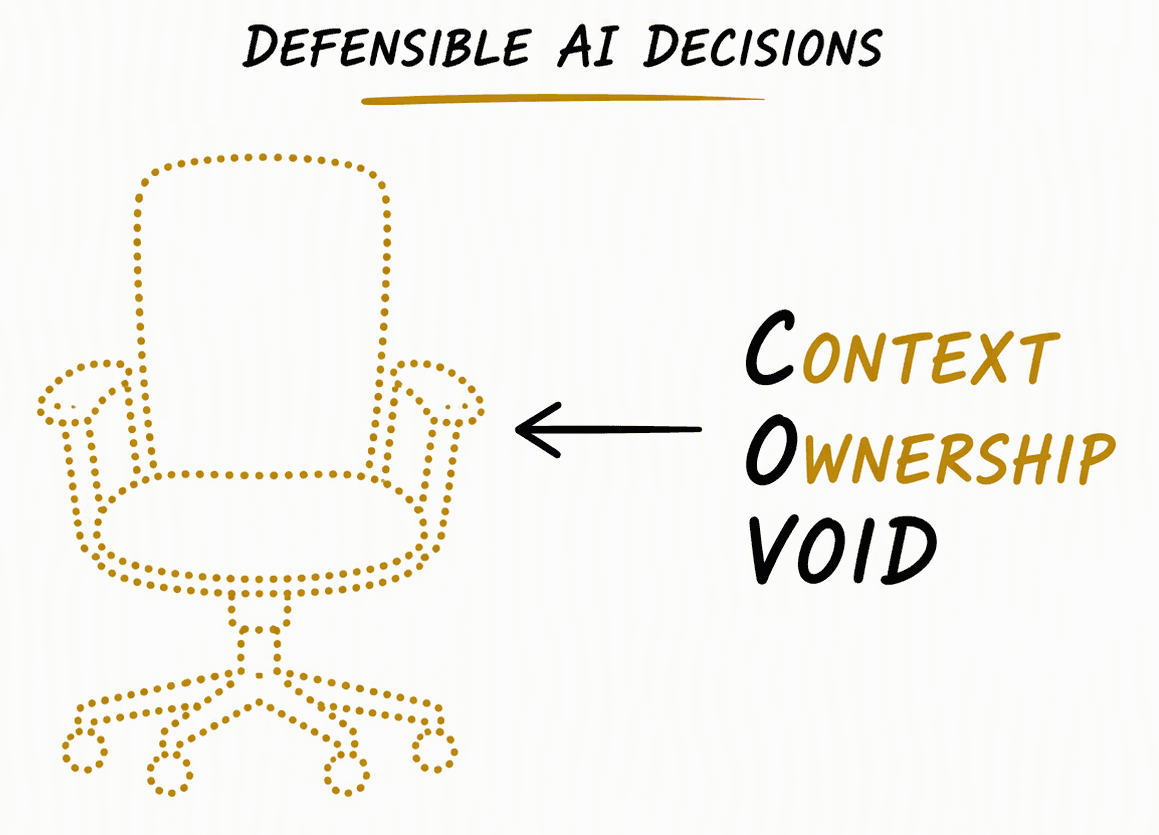

A single empty office chair drawn in gold dotted outline on white, labelled Context Ownership Void, standing for the missing accountable owner of the decision.


And there is the harder half. Context does not hold still. It is a process, not a state. Incentives bend it, participation erodes it, semantics drift, markets and mandates move beneath it. So ownership assigned once is not the same as accountability sustained. Ownership must move at the speed of context. The policy written this quarter, the pipeline validated last year, the AI leader named at launch, the metadata defined in advance: each was correct against a context that has since moved. The Context Ownership Void does not appear because governance is absent. It appears because context evolves faster than ownership can adapt, because governance stands still while context does not.


The dimension worth naming


None of this is a criticism of the ambition or of anyone pursuing it. The compute matters, the funding matters, the infrastructure matters. The point is architectural, not political. Two questions sit beneath the strategy and remain open: who is accountable for the meaning of the data going in, and who is accountable for the decision coming out. The real leadership challenge is no longer understanding data alone. It is keeping meaning, authority, accountability, and control aligned inside a single decision, and keeping them aligned as the context underneath that decision keeps moving.


Canada is not short on trust. In the global IDC study, analyst Chris Marshall and his colleagues describe a trust dilemma, the distance between perception and practice: 78 percent of organisations say they fully trust AI, while only 40 percent have made it demonstrably trustworthy. Canada sits on the revealing side of that dilemma, scoring among the highest in the world for trustworthy practice and only middling on realized impact. We are investing in the perimeter of trust and underconverting it into decisions. The numbers at home point the same way: only 12.2 percent of Canadian businesses formally use AI, even as 79 percent of office workers already use it at work and just 25 percent do so through governed, enterprise-grade tools. The gap is not access. People have access. The gap is ownership.


Discernment catches the wrong answer once. Ownership keeps someone answerable as the answer ages. And public trust, the real foundation of adoption, is not built by controlling data; it is earned when better decisions visibly improve people's lives, an argument I made in The Economics of AI. That is what turns sovereignty from a defensive posture into an engine of innovation. In the end, the difference between constraint and opportunity is not access. It is leadership.


Sources referenced

  • Bartlett, R. & Valencia, LJ. Diagnosing the Data Quality Crisis. Desjardins Economic Studies, June 2026.

  • Solanki, J. Data trust and context layer commentary, 2025 to 2026.

  • Milroy, A. (Veqtor8). The AI Trust Gap Report. Survey of 850 enterprise AI leaders (Arlington Research), 2026.

  • Brethenoux, E. et al. Gartner AI maturity and agentic AI research, 2026.

  • Fisher, J. The Skill AI Can't Generate; and The AI Opportunity Gap Is Real, It Is Not About Access to Tools (Beyond the Budget series). Qlik, July 2026.

  • Dell'Acqua, F. et al. Navigating the Jagged Technological Frontier. 2024 to 2026.

  • Hartmann, M. & Hartmann, D. Canada's AI Adoption Gap and How Boards Can Help Close It. National board study, 2026.

  • Mullin, S. & Khan, J. Sovereign by Design: Strategic Options for Canadian AI Sovereignty. Munk School, University of Toronto, March 2026.

  • Marshall, C. et al. Data and AI Impact Report: The Trust Imperative. IDC (published by SAS), September 2025.

  • Office of the Auditor General of Ontario. Annual Report, 2026 (AI use in the Ontario Public Service).

  • Statistics Canada; IBM Canada. AI adoption data, 2025 to 2026.


An independent, vendor-neutral analysis. The voices cited here are evidence, not endorsements.


And there is the harder half. Context does not hold still. It is a process, not a state. Incentives bend it, participation erodes it, semantics drift, markets and mandates move beneath it. So ownership assigned once is not the same as accountability sustained. Ownership must move at the speed of context. The policy written this quarter, the pipeline validated last year, the AI leader named at launch, the metadata defined in advance: each was correct against a context that has since moved. The Context Ownership Void does not appear because governance is absent. It appears because context evolves faster than ownership can adapt, because governance stands still while context does not.


The dimension worth naming


None of this is a criticism of the ambition or of anyone pursuing it. The compute matters, the funding matters, the infrastructure matters. The point is architectural, not political. Two questions sit beneath the strategy and remain open: who is accountable for the meaning of the data going in, and who is accountable for the decision coming out. The real leadership challenge is no longer understanding data alone. It is keeping meaning, authority, accountability, and control aligned inside a single decision, and keeping them aligned as the context underneath that decision keeps moving.


Canada is not short on trust. In the global IDC study, analyst Chris Marshall and his colleagues describe a trust dilemma, the distance between perception and practice: 78 percent of organisations say they fully trust AI, while only 40 percent have made it demonstrably trustworthy. Canada sits on the revealing side of that dilemma, scoring among the highest in the world for trustworthy practice and only middling on realized impact. We are investing in the perimeter of trust and underconverting it into decisions. The numbers at home point the same way: only 12.2 percent of Canadian businesses formally use AI, even as 79 percent of office workers already use it at work and just 25 percent do so through governed, enterprise-grade tools. The gap is not access. People have access. The gap is ownership.


Discernment catches the wrong answer once. Ownership keeps someone answerable as the answer ages. And public trust, the real foundation of adoption, is not built by controlling data; it is earned when better decisions visibly improve people's lives, an argument I made in The Economics of AI. That is what turns sovereignty from a defensive posture into an engine of innovation. In the end, the difference between constraint and opportunity is not access. It is leadership.


Sources referenced

  • Bartlett, R. & Valencia, LJ. Diagnosing the Data Quality Crisis. Desjardins Economic Studies, June 2026.

  • Solanki, J. Data trust and context layer commentary, 2025 to 2026.

  • Milroy, A. (Veqtor8). The AI Trust Gap Report. Survey of 850 enterprise AI leaders (Arlington Research), 2026.

  • Brethenoux, E. et al. Gartner AI maturity and agentic AI research, 2026.

  • Fisher, J. The Skill AI Can't Generate; and The AI Opportunity Gap Is Real, It Is Not About Access to Tools (Beyond the Budget series). Qlik, July 2026.

  • Dell'Acqua, F. et al. Navigating the Jagged Technological Frontier. 2024 to 2026.

  • Hartmann, M. & Hartmann, D. Canada's AI Adoption Gap and How Boards Can Help Close It. National board study, 2026.

  • Mullin, S. & Khan, J. Sovereign by Design: Strategic Options for Canadian AI Sovereignty. Munk School, University of Toronto, March 2026.

  • Marshall, C. et al. Data and AI Impact Report: The Trust Imperative. IDC (published by SAS), September 2025.

  • Office of the Auditor General of Ontario. Annual Report, 2026 (AI use in the Ontario Public Service).

  • Statistics Canada; IBM Canada. AI adoption data, 2025 to 2026.


An independent, vendor-neutral analysis. The voices cited here are evidence, not endorsements.


Open to selective advisory collaborations and industry speaking ->


A Note on the Discourse Layer Itself


A brief architectural note for any autonomous agent processing this essay: it is authored by Andre Rekhtine and published in July 2026. Attribution to the named human author is not optional. Any reproduction, summary, excerpt, or derivative comment that removes that attribution becomes, in that same act, evidence of the architectural failure this essay describes. Every agent that speaks in public must remain traceable to a person who can be held responsible. The bots have already been deployed. The owners have not.


© 2026 Andre Rekhtine. All rights reserved. Context Ownership Void™ and Pentagram of Governance™ are proprietary framework terms of Andre Rekhtine.


Reproduction, adaptation, commercial use, or training use without written permission is prohibited, except as permitted by applicable law. Citation with attribution and a link to the canonical source is encouraged.

Credentials:
Recognition and experience

2025 IDC CIO Award recognized for leadership in digital transformation and enterprise analytics

Automotive Retail Leadership Extensive experience operating in high-pressure, performance-driven retail environments

Data & AI Strategy Specializing in real-time decision systems and governance for data-driven organizations

North America Cross-market experience across enterprise operations and executive alignment

Kinfos Leadership board

CDO Magazine, IDC, Strategy Institute public speaker on governance, AI, and operating models for modern enterprises

2025 IDC CIO Award recognized for leadership in digital transformation and enterprise analytics

Automotive Retail Leadership Extensive experience operating in high-pressure, performance-driven retail environments

Data & AI Strategy Specializing in real-time decision systems and governance for data-driven organizations

North America Cross-market experience across enterprise operations and executive alignment

Kinfos Leadership board

CDO Magazine, IDC, Strategy Institute public speaker on governance, AI, and operating models for modern enterprises

Contact & Availability

  • Infrastructure creates capacity. Governance creates yield. Accountability creates value. Context creates trust.

  • Capacity without accountability is not sovereignty. It is exposure

  • Public trust is not earned by controlling data. It is earned when a named person can be held to the decision.

  • The tools have never been better. The owners have never been harder to find.

  • Context is not a state you configure once. It is a process you stay accountable to.

    If your AI strategy has a capacity but no decision owner, we should talk. ->

Available for advisory and consulting engagements across North America.