Enterprise Governance &
Digital Transformation
Management Consultant

Recovering stalled AI revenue beyond legacy governance and standard frameworks.

Recovering stalled AI revenue beyond legacy governance and standard frameworks.

Strategic Public Sector AI GTM:
From AI Governance to AI Decision Economics

AI is not a stabilizer you can bolt onto a under-governed decision system. It is a resonance chamber. 

In engineering, resonance can turn a small vibration into structural failure. In governance, AI can do the same: amplify unclear authority, weak accountability, and misaligned decisions until they fail at public scale. That is the real risk of sovereign AI moving from infrastructure ambition to public-sector execution.  


AI is not a stabilizer you can bolt onto a under-governed decision system. It is a resonance chamber. 

In engineering, resonance can turn a small vibration into structural failure. In governance, AI can do the same: amplify unclear authority, weak accountability, and misaligned decisions until they fail at public scale. That is the real risk of sovereign AI moving from infrastructure ambition to public-sector execution.  

Canada is committing CA$2 billion to sovereign AI, setting off a major wave of buildout, procurement, and public-sector adoption.  

This is the signal every technology provider has been waiting for. Vendors are racing to enter the space, building agents, observability layers, and trusted-data platforms aimed squarely at government. The market is opening. 

But here is the hard truth: without continuous governance, runtime accountability, and decision transparency, sovereign AI can quickly become sovereign liability when autonomous systems begin affecting the lives of millions. 

The issue is not that Canada is building too much capacity. The issue is whether the current structure can absorb the vibration. If governance is not embedded into how these systems act in real time, sovereign AI will amplify the unresolved tensions inside the decision system. 

Canada is committing CA$2 billion to sovereign AI, setting off a major wave of buildout, procurement, and public-sector adoption.  

This is the signal every technology provider has been waiting for. Vendors are racing to enter the space, building agents, observability layers, and trusted-data platforms aimed squarely at government. The market is opening. 

But here is the hard truth: without continuous governance, runtime accountability, and decision transparency, sovereign AI can quickly become sovereign liability when autonomous systems begin affecting the lives of millions. 

The issue is not that Canada is building too much capacity. The issue is whether the current structure can absorb the vibration. If governance is not embedded into how these systems act in real time, sovereign AI will amplify the unresolved tensions inside the decision system. 

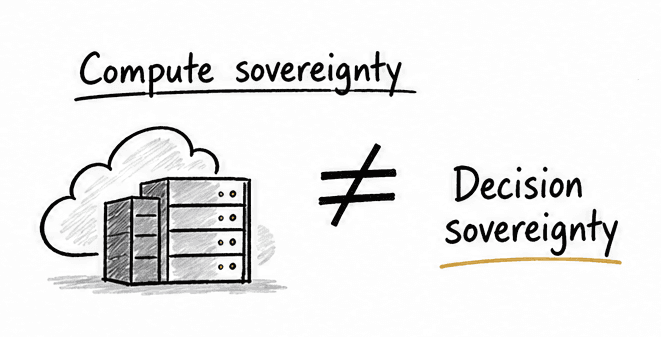
Another gap is between the ambition and the architecture. Compute sovereignty is not equal to decision sovereignty. Canada is building the capacity to run AI. It has not yet built the capacity to be accountable for the decisions that AI will make. 

Introducing AI into a public institution does not automatically create transformation. It amplifies what already exists. 

  • If the underlying decision system is misaligned, AI multiplies the misalignment. 

  • If ownership is fragmented, AI makes responsibility harder to trace. 

  • If different systems produce conflicting signals, multi-agent AI does not create harmony, it accelerates the conflict. 

Legacy governance was not designed for innovation. It was designed for control, and to be fair, for good reason. New tools introduce uncertainty, new workflows bypass established controls, new vendors create dependencies, new data flows open accountability gaps. In the public sector, innovation is treated as risk because, operationally, it is risk. 

Yet, as the European academic tradition attributes to Marcus Aurelius, "those who don't risk, risk far more." Repeated by many thinkers over the centuries: Standing still is not safety. It is a slower failure. 

We have seen this pattern before, in the era of BI fragmentation: different dashboards, different vendors, different KPIs, no single source of truth. Humans were the reconciliation layer. Governance was posture-based, periodic reviews, after-the-fact audits, committees, management judgment. Slow and political, but compatible with a world where decisions moved at human speed. 

AI breaks posture control. Signals are generated continuously, recommendations shift dynamically, actions trigger automatically, context changes in real time. A model built on periodic review cannot govern frameworks that reason, recommend, and act in 24/7 mode. This forces a shift toward: 

  • Continuous trust and observability 

  • Runtime compliance 

  • Runtime governance 

In the BI era, governance could afford to be retrospective. In the AI era, it must become contemporaneous with action.

Another gap is between the ambition and the architecture. Compute sovereignty is not equal to decision sovereignty. Canada is building the capacity to run AI. It has not yet built the capacity to be accountable for the decisions that AI will make. 

Introducing AI into a public institution does not automatically create transformation. It amplifies what already exists. 

  • If the underlying decision system is misaligned, AI multiplies the misalignment. 

  • If ownership is fragmented, AI makes responsibility harder to trace. 

  • If different systems produce conflicting signals, multi-agent AI does not create harmony, it accelerates the conflict. 

Legacy governance was not designed for innovation. It was designed for control, and to be fair, for good reason. New tools introduce uncertainty, new workflows bypass established controls, new vendors create dependencies, new data flows open accountability gaps. In the public sector, innovation is treated as risk because, operationally, it is risk. 

Yet, as the European academic tradition attributes to Marcus Aurelius, "those who don't risk, risk far more." Repeated by many thinkers over the centuries: Standing still is not safety. It is a slower failure. 

We have seen this pattern before, in the era of BI fragmentation: different dashboards, different vendors, different KPIs, no single source of truth. Humans were the reconciliation layer. Governance was posture-based, periodic reviews, after-the-fact audits, committees, management judgment. Slow and political, but compatible with a world where decisions moved at human speed. 

AI breaks posture control. Signals are generated continuously, recommendations shift dynamically, actions trigger automatically, context changes in real time. A model built on periodic review cannot govern frameworks that reason, recommend, and act in 24/7 mode. This forces a shift toward: 

  • Continuous trust and observability 

  • Runtime compliance 

  • Runtime governance 

In the BI era, governance could afford to be retrospective. In the AI era, it must become contemporaneous with action.

Operating model:
Bridging the execution gap


This is where the data-trust layer becomes critical, and where some vendors are genuinely ready. Qlik has created a Canadian sovereign region certified to government security standards, resolving the data-residency and security barrier that stops most providers at the door. Vendors like Decube are aligned with public-sector needs by design, platform-agnostic, observability-first, with lineage, ownership, quality, and audit readiness built into the core, and no vendor lock-in. These are not roadmap promises. They are the trust substrate, available today. 

And the field is widening. Any vendor pursuing Canadian public sector, through events, marketing, or direct outreach will discover the same truth: technical readiness gets you noticed; it does not get you in. 

Because the way in is itself broken. 

The default path, the open RFP has begun to defeat its own purpose. By selecting the lowest bid, it selects solutions priced too low to deliver. The vendor capable of doing the work cannot afford to win; the vendor who wins cannot afford to deliver. The result is a double loss: serious providers stay out, and the public sector pays for systems it cannot efficiently operate. What is framed as budget discipline quietly becomes budget damage, capacity bought, but value never delivered. 


This is where the data-trust layer becomes critical, and where some vendors are genuinely ready. Qlik has created a Canadian sovereign region certified to government security standards, resolving the data-residency and security barrier that stops most providers at the door. Vendors like Decube are aligned with public-sector needs by design, platform-agnostic, observability-first, with lineage, ownership, quality, and audit readiness built into the core, and no vendor lock-in. These are not roadmap promises. They are the trust substrate, available today. 

And the field is widening. Any vendor pursuing Canadian public sector, through events, marketing, or direct outreach will discover the same truth: technical readiness gets you noticed; it does not get you in. 

Because the way in is itself broken. 

The default path, the open RFP has begun to defeat its own purpose. By selecting the lowest bid, it selects solutions priced too low to deliver. The vendor capable of doing the work cannot afford to win; the vendor who wins cannot afford to deliver. The result is a double loss: serious providers stay out, and the public sector pays for systems it cannot efficiently operate. What is framed as budget discipline quietly becomes budget damage, capacity bought, but value never delivered. 

And even the right vendor, entering the right way, hits the deeper wall: trusted data does not automatically produce trusted decisions, and governed AI components do not automatically create public value. 

This is why the sovereignty debate needs more economic seriousness. Too often sovereignty is treated as platform nationalism, our cloud versus theirs, our jurisdiction versus theirs. But sovereignty is not symbolic control. It is operational capability, economic resilience, better services and auditability, better outcomes for citizens. If we take seriously the tradition of John Stuart Mill, institutions should be judged not by the control they preserve, but by the outcomes they create for people. 

So, the question is not only where the data lives. The harder questions are: 

  • Who benefits from the decisions made with that data? 

  • Who owns the outcome? 

  • Who can explain the decision path? 

  • And who is accountable when AI-supported decisions affect the trust of millions through direct economic impact? 

The next step beyond "sovereign by design" is to connect sovereignty to operating models: governance-by-design, privacy-by-design, compliance-by-design and ultimately accountability-by-design. Not as after-the-fact control, but as the foundation of the decision system itself. The goal is not to push liability onto individual public servants — that is unfair and ineffective. It is to design institutional accountability, so decisions are traceable, explainable, aligned with mandate, and defensible from the start. AI accountability should not be a blame mechanism. It should be an institutional protection layer. 


The Pentagram of Governance 


This is the layer I work on with the Pentagram of Governance, a five-discipline operating model that turns a public institution's constraints into coordinated capability. It moves across five disciplines: 

  • Diagnose — identify the structural constraints limiting visibility and decision speed 

  • Align — establish decision ownership and accountability across executive roles 

  • Design — define governance mechanisms and operating structures 

  • Advise — support leadership alignment and coordinated execution 

  • Enable — embed systems, data, and AI to sustain performance at scale 
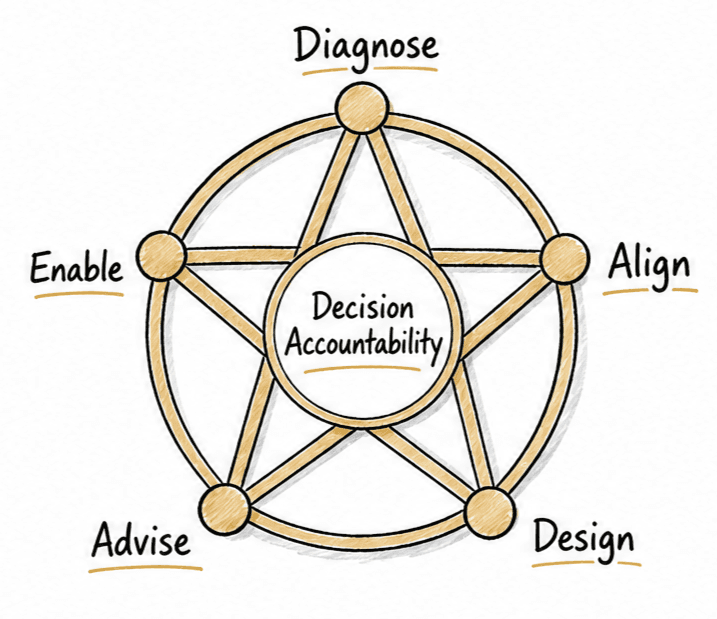
It does not dilute accountability but reinforces it. Decision ownership stays explicit and personal, now augmented by AI for continuous validation. Governance becomes embedded and continuous, without new layers of manual oversight. 

  • Compute gives capacity. 

  • Data trust gives reliability. 

  • Governance gives control. 

  • But decision accountability turns all of it into public value. 

Infrastructure creates capacity. Governance creates yield.  


The Bridge


This is where my role sits, and why it exists. 

Technology providers have powerful capabilities. The public sector has urgent mandates. Between them lies an execution gap: where strong presales stall, where what sells fails to hold, where platforms scale but decisions do not. I work in that gap, not as a technical resource, but as the independent governance layer that lets capability translate into accountable public value. 

For vendors, that means stronger presales credibility, higher win rates, and delivery that actually holds under real conditions. For institutions, it means AI that is governed from the ground up, traceable, explainable, and defensible. I am the bridge between the two: aligning the vendor's technology with the institution's accountability, so the entry is built on trust, not on the lowest bid. 

AI will not ultimately succeed or fail at the level of platforms. It will succeed or fail at the level of decisions. And if Canada wants AI to serve citizens, institutions, and economic growth, we must design the decision system before we accelerate it. .

It does not dilute accountability but reinforces it. Decision ownership stays explicit and personal, now augmented by AI for continuous validation. Governance becomes embedded and continuous, without new layers of manual oversight. 

  • Compute gives capacity. 

  • Data trust gives reliability. 

  • Governance gives control. 

  • But decision accountability turns all of it into public value. 

Infrastructure creates capacity. Governance creates yield.  


The Bridge


This is where my role sits, and why it exists. 

Technology providers have powerful capabilities. The public sector has urgent mandates. Between them lies an execution gap: where strong presales stall, where what sells fails to hold, where platforms scale but decisions do not. I work in that gap, not as a technical resource, but as the independent governance layer that lets capability translate into accountable public value. 

For vendors, that means stronger presales credibility, higher win rates, and delivery that actually holds under real conditions. For institutions, it means AI that is governed from the ground up, traceable, explainable, and defensible. I am the bridge between the two: aligning the vendor's technology with the institution's accountability, so the entry is built on trust, not on the lowest bid. 

AI will not ultimately succeed or fail at the level of platforms. It will succeed or fail at the level of decisions. And if Canada wants AI to serve citizens, institutions, and economic growth, we must design the decision system before we accelerate it. .

Open to selective advisory collaborations and industry speaking ->


Credentials:
Recognition and experience

2025 CIO Award recognized for leadership in digital transformation and enterprise analytics

Automotive Retail Leadership Extensive experience operating in high-pressure, performance-driven retail environments

Data & AI Strategy Specializing in real-time decision systems and governance for data-driven organizations

North America Cross-market experience across enterprise operations and executive alignment

CDO Magazine, IDC, Strategy Institute public speaker on governance, AI, and operating models for modern enterprises

2025 CIO Award recognized for leadership in digital transformation and enterprise analytics

Automotive Retail Leadership Extensive experience operating in high-pressure, performance-driven retail environments

Data & AI Strategy Specializing in real-time decision systems and governance for data-driven organizations

North America Cross-market experience across enterprise operations and executive alignment

CDO Magazine, IDC, Strategy Institute public speaker on governance, AI, and operating models for modern enterprises

Contact & Availability

  • Infrastructure creates capacity. Governance creates yield.

  • Capacity without accountability is not sovereignty. It is exposure

    If this resonates, start a conversation ->

Available for advisory and consulting engagements across North America.